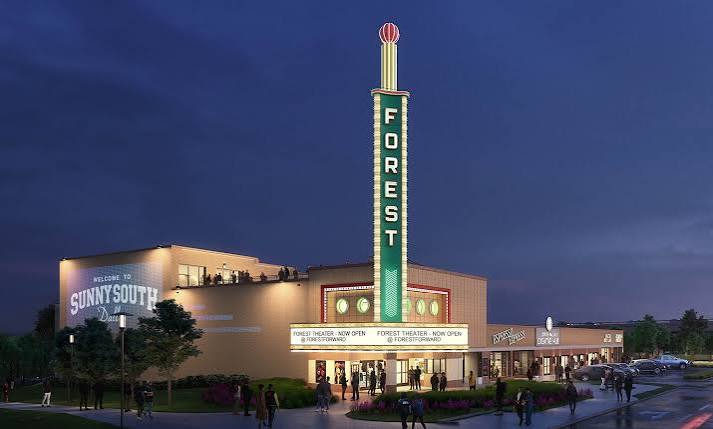
Here’s a South Dallas story I couldn’t wait to share. On Sunday night, Nov. 1, a crowd packed Martin Luther King Jr. Boulevard to watch the Forest Theater’s tower light up for the first time in more than 50 years. Dallas’ own Erykah Badu was there to welcome everyone home. My favorite moment, though, came from Willie Mae Coleman, a 92-year-old South Dallas neighbor, who told a reporter, “I’m so happy. I told them I’m coming every day.”
That’s the Forest in a nutshell. It’s part of the fabric of South Dallas, and the backstory is a good one. Let’s start in 1949.
Opening night, 1949
The Forest was built by Karl Hoblitzelle, the man behind the Interstate Theatres chain (yes, the same name behind the Hoblitzelle Foundation). It opened on July 30, 1949, with the baseball comedy It Happens Every Spring, and reports from the time say 4,500 to 5,000 people turned out. The building, designed by Pettigrew & Worley, was Streamline Moderne, with roughly 1,400 seats and the tall tower that became its signature.
It opened in the segregation era, in what was then a thriving, largely Jewish South Dallas neighborhood.
A neighborhood that changed around it
If you’ve ever wondered why South Dallas looks the way it does today, part of the answer is the highway. Construction cut through the neighborhood in the years that followed and destroyed thousands of homes.
In 1956, the Forest closed briefly and reopened on March 1 to serve Black audiences. The neighborhood embraced it, and the Forest became one of South Dallas’s favorite places to gather.
After the movies stopped
Movie ticket sales fell, and the Forest closed as a cinema in September 1965. But this building never stayed quiet for long. Over the next few decades it kept coming back:
- 1967 the Central Forest Club opened as a soul and blues nightclub, with acts like Redd Foxx and B.B. King
- 1968 concerts in the Forest Ballroom included Wilson Pickett and The Byrds
- 1970s and 1980s a short-lived cinema, then a run of nightclubs
- 1991 a jazz club, booking acts like Ramsey Lewis
Over its life, the Forest’s stage also hosted Gladys Knight, Ike & Tina Turner and Prince. Forest Forward’s CEO, Elizabeth Wattley, summed up those years this way: “It was a wave of openings and closures.”
The Black Forest Theater
This next chapter is the one a lot of Dallas remembers. In 2003, Erykah Badu, who grew up in the area, took over the building and renamed it the Black Forest Theater. She worked to bring it up to code, hosted live music and film nights, and added educational programs for young people. She later said she took significant financial losses, and the theater closed again in 2008.
The dark years, and the save
For most of the next decade, the Forest sat empty, and by 2015 it faced possible demolition. Thankfully, Preservation Dallas stepped in and pushed for landmark protection. In 2017, philanthropists Linda and Jon Halbert bought the building, and it became the anchor of the effort now called Forest Forward, a nonprofit since 2020 led by Elizabeth Wattley.
Here’s my favorite detail in the whole story: Forest Forward set its fundraising goal at $75,215,000, a nod to the theater’s ZIP code, 75215. The City of Dallas contributed an $8 million grant, more than 18 foundations invested, and the Dallas Morning News puts the total relaunch at more than $80 million. By 2025, 78% of the project’s contracts had gone to Black- and minority-owned businesses.
What’s inside now
- A 1,000-seat concert hall for concerts, plays, dance and comedy
- A 200-seat black box theater with retractable seating
- Recording and podcast studios plus spaces for visual and immersive art
- A 13,000-square-foot creative education lab used by students from the nearby MLK Jr. Arts Academy and by adults
- A coffee shop and a rooftop gathering space for everyday visits, not just show nights
If you want to see it for yourself, through April the theater plans tours, “first experiences” and art walks, with artwork from local artists and the African American Museum at Fair Park.
What This Means If You’re Buying, Selling, or Investing
- If you love Dallas history this is one of the city’s great comeback stories, and the next few months are an easy time to tour it.
- If you’re watching South Dallas Forest Forward’s plan reaches beyond the theater, with arts education alongside Dallas ISD and mixed-income housing in its strategy. It’s a long-term, community-led effort to follow.
- If you’re new to Dallas a show at the Forest is a good way to see a part of the city many newcomers never visit.
A Piece of South Dallas History, Coming Home
Plenty of old Dallas theaters have been lost. The Forest came close more than once, and it’s still standing because people kept fighting for it, from Erykah Badu in the 2000s to the neighbors, preservationists and donors who brought it back. For longtime residents, it’s a piece of history coming home. For everyone else, it’s a great reason to spend an evening in South Dallas. If you haven’t been, put it on your Dallas to-do list, and when you get there, look up at that tower.
Frequently asked questions
When did the Forest Theater open?
The Forest Theater opened on July 30, 1949, with the baseball comedy It Happens Every Spring. It was built by Karl Hoblitzelle of the Interstate Theatres chain and designed by Pettigrew & Worley in the Streamline Moderne style, with roughly 1,400 seats and the tall tower that became its signature.
When was the Forest Theater’s tower lit again?
On Sunday night, Nov. 1, a crowd packed Martin Luther King Jr. Boulevard to watch the tower light up for the first time in more than 50 years, with Erykah Badu there to welcome everyone home.
What is inside the Forest Theater now?
A 1,000-seat concert hall, a 200-seat black box theater with retractable seating, recording and podcast studios, spaces for visual and immersive art, a 13,000-square-foot creative education lab used by students from the nearby MLK Jr. Arts Academy and by adults, and a coffee shop and rooftop gathering space.
What happened to the Forest Theater after it closed as a cinema?
The Forest closed as a cinema in September 1965, then came back as the Central Forest Club in 1967, the Forest Ballroom in 1968 and a jazz club in 1991. Erykah Badu took it over as the Black Forest Theater in 2003, and it closed again in 2008, before Preservation Dallas pushed for landmark protection and Linda and Jon Halbert bought the building in 2017.
Sources: CBS Texas, Dallas Morning News, CultureMap Dallas, Dallas Weekly, Cinema Treasures, Communities Foundation of Texas
Know the Neighborhood, Not Just the House
I’m Jamie Marancenbaum, and I help people buy and sell homes across Dallas, Far North Dallas and the greater DFW area. A good move is about more than square footage and comps. It’s about the streets, the schools, what’s being built down the road, and the stories behind the places you drive past every day. That’s what I write about here, and it’s what I bring to every client.
Thinking about buying, selling, or just curious what your home is worth today? Get your free home value at Get My Home Value, or reach me anytime at (469) 417-9661 or [email protected].
Jamie Marancenbaum, REALTOR® | Midtown Market Group | Coldwell Banker Apex | Texas License #0645858
18260 Preston Road, Suite 110, Dallas, TX 75252
Dallas | Richardson | Far North Dallas | Addison | Plano | DFW Area
More than real estate. It’s Home.