If you’re relocating to Dallas and Jewish community life is a priority for your family — schools, synagogues, kosher dining, walkable Shabbat access — Far North Dallas is one of the most established and desirable Jewish communities in the entire country. And it’s growing faster than most people realize.
This guide covers everything you need to know: the community infrastructure, the Eruv boundaries and their recent expansion, the schools, the kosher dining, and what all of it means if you’re buying or selling in this corridor.
1. Dallas’s Jewish Community — The Big Picture
Dallas is home to an estimated 80,000 Jews — making it one of the largest Jewish communities in the United States. The Dallas area, including Arlington, Irving, Plano, and Richardson, is a close second to Houston as the state’s largest Jewish community, and Texas as a whole is home to approximately 175,000 Jews.
The numbers are significant:
- 6 Jewish day schools serving the Dallas area
- 16 kosher restaurants and caterers, according to the Jewish Federation of Greater Dallas
- 47 synagogues of all denominations across North Texas
- Multiple eruv boundaries serving different Dallas-area communities
And the community is actively growing. In the wake of rising antisemitism in coastal cities, wildfires in California, and declining quality of life in major urban centers, Jewish families from Los Angeles, New York, Toronto, and beyond have been choosing Dallas in significant numbers. The combination of Texas’s zero state income tax, a lower cost of living, a booming job market, and an established, welcoming Jewish community has made Dallas — and Far North Dallas specifically — one of the most sought-after Jewish communities in America.
Sources: Jewish Federation of Greater Dallas / Jewish Telegraphic Agency, December 2025 / Philadelphia Jewish Exponent, January 2026
2. What Is an Eruv — and Why Does It Matter for Real Estate?
For readers who are unfamiliar: an Eruv is a symbolic boundary — typically defined by a series of utility poles and wire — that allows observant Jewish families to carry objects and push strollers on Shabbat and Jewish holidays, activities that would otherwise be restricted in public spaces under traditional Jewish law.
For observant Jewish families, being within an Eruv boundary is not a preference — it’s a requirement for full participation in Shabbat life. Families with young children especially need to be within the eruv to carry car seats, push strollers, and move freely through their neighborhood on Shabbat and holidays.
This makes Eruv boundaries a direct driver of real estate demand. Homes within a well-maintained eruv — especially one with strong community infrastructure like synagogues, schools, and kosher dining within walking distance — command sustained demand from a buyer pool that specifically seeks them out. That demand doesn’t fluctuate with interest rates or market cycles the way general demand does. It’s structural.
In practical terms: homes within the Far North Dallas Eruv are almost always spoken for quickly when they come to market. And with the recent expansion adding 1,000+ homes to the boundary, the addressable community has grown significantly.
3. The Far North Dallas Eruv — Boundaries and the Recent Expansion
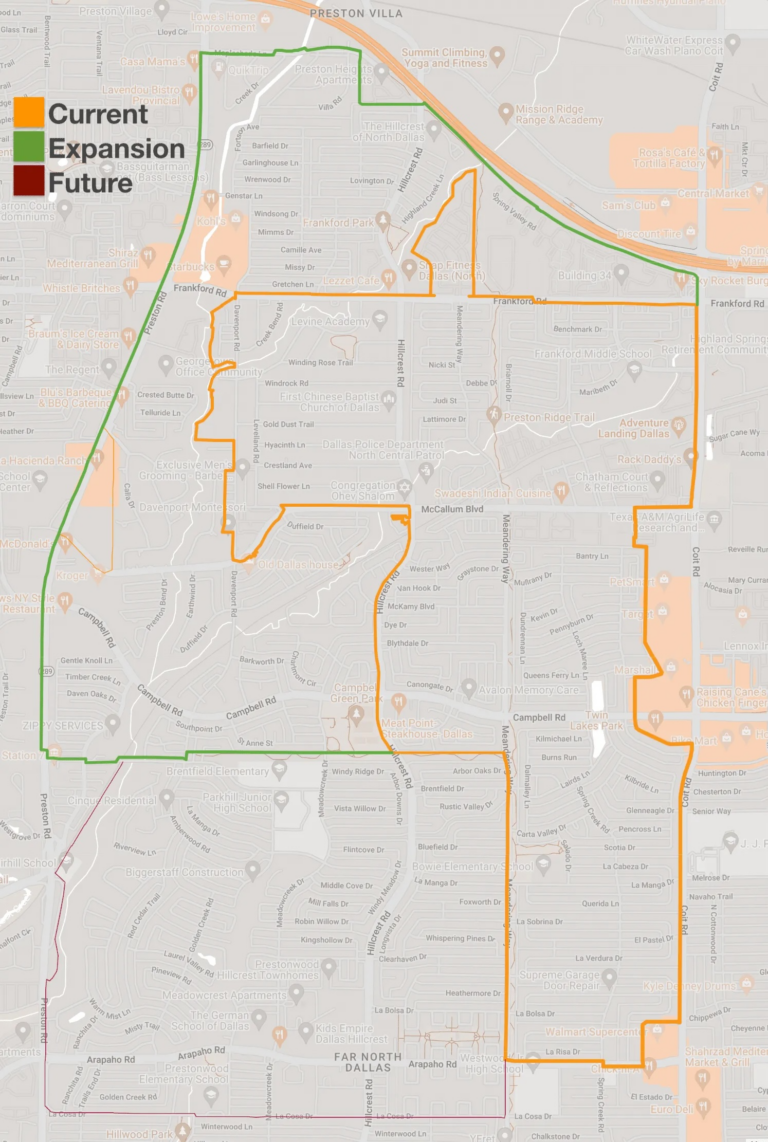
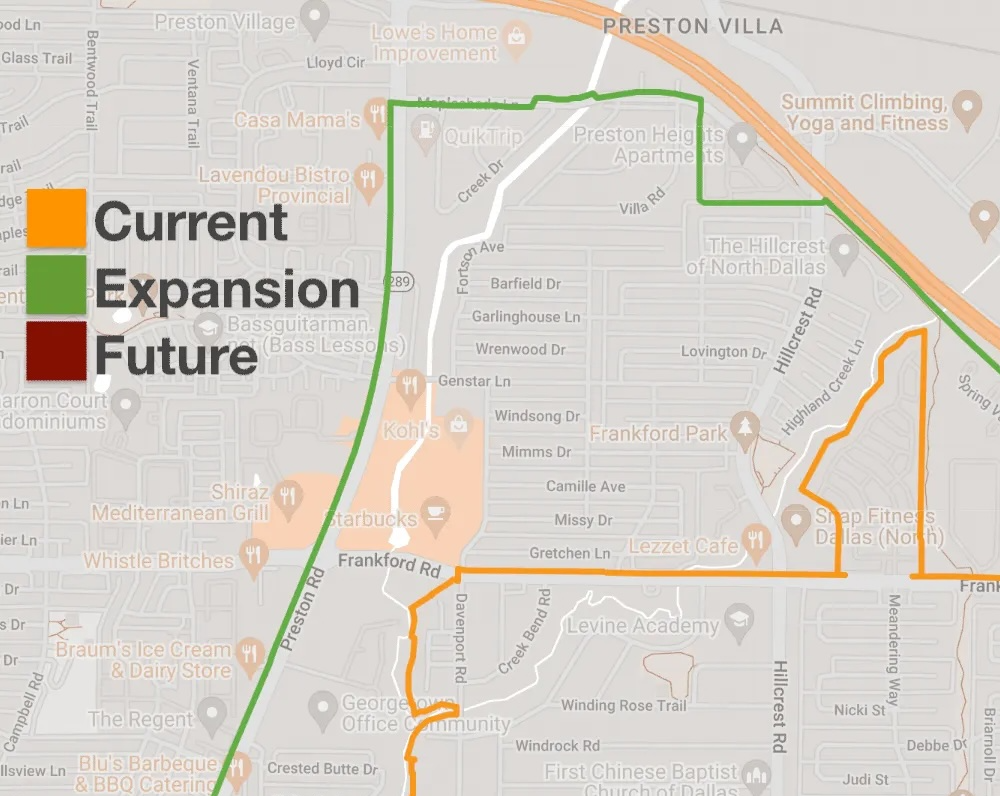
The Far North Dallas Eruv covers a substantial portion of the 75248 zip code and surrounding streets — roughly bounded by Frankford Road on the north, Coit Road on the east, Arapaho Road on the south, and Preston Road on the west, with the established community centered around Hillcrest Road between Frankford and Campbell.
The Eruv recently completed a significant expansion — adding more than 1,000 homes and three new parks to the boundary. The expanded zone extends further west past Preston Road and further south past Arapaho, bringing a substantial number of additional households into the community’s walkable Shabbat radius.
The expansion is complete and the new boundaries are active. For families evaluating specific streets and addresses, the current boundary map is maintained at toraschaimdallas.org.
One sign of a community’s health: the people in it invest in it. The Eruv expansion required significant fundraising, coordination with utility companies, and rabbinical oversight — none of which happens unless a community is confident it is growing and intends to stay. That confidence is well-founded.
4. The Community Infrastructure
What makes Far North Dallas genuinely exceptional — compared to Jewish communities in other Texas cities or even other Dallas neighborhoods — is the depth of its community infrastructure. This isn’t a community that’s growing into its institutions. The institutions are already here.
Synagogues:
- Congregation Toras Chaim — The anchor of the Far North Dallas eruv community. Orthodox synagogue and the administrative home of the Eruv.
- Congregation Ohev Shalom — Established Conservative congregation within the eruv boundaries.
- Chabad of Dallas — Welcoming Chabad house serving families of all backgrounds and observance levels.
- Congregation Shaare Tefilla — Modern Orthodox synagogue with 175+ families, described as the hub of Modern Orthodox life in Dallas.
- Ohr HaTorah — Additional Orthodox congregation serving the North Dallas corridor.
Schools:
- Torah Day School of Dallas — Co-ed Orthodox Jewish day school, K–8, within the eruv boundaries.
- Akiba Academy of Dallas — Community Jewish day school with students of all backgrounds and observance levels.
- Yavneh Academy of Dallas — Modern Orthodox day school.
- Mesorah High School for Girls — Orthodox high school for girls.
Kosher Dining and Provisions:
- Tom Thumb Kosher Meat, Fish & Bakery — Full-service kosher grocery department within an established supermarket, accessible within the Eruv.
- Natalie’s Kitchen — Kosher restaurant within the community.
- Cafe Fino Pizza — Kosher pizza and casual dining.
- Meat Point — 7114 Campbell Road, Suite 102. The anchor of the kosher dining scene at Campbell and Hillcrest, open since 2013. Israeli-American steakhouse run by Yehuda and Lital Alila — Mediterranean lunch, full steakhouse dinner, over 100 kosher wines, private dining for up to 60 guests, live music Thursday nights, and a beloved pre-Shabbos Kabbalat Shabbat on Fridays. meatpointdallas.com · (972) 380-1010
- Pizza Ella — 7134 Campbell Road, Suite A. The Alila family’s newest addition, right next door to Meat Point. Kosher New York-style and Neapolitan pizzas, fresh breakfast daily until 2pm, welcoming outdoor patio. Open seven days including Saturday nights. @pizzaelladallas · (972) 805-4888
- The Green Room — 7130 Campbell Road, Suite 205. Also owned by the Alila family, in the same plaza. A 5,000 sq ft event venue for weddings, bar/bat mitzvahs, corporate events, and celebrations. Redesigned dance floor, state-of-the-art sound and lighting, private dressing suite, built-in bar, full kosher catering available. Up to 220 guests. thegreenroomdallas.com · (972) 400-8356
Dallas as a whole has 16 kosher restaurants and caterers — a number that reflects both the size of the community and the depth of its infrastructure.
5. Why Families Are Choosing Dallas Right Now
The story of Jewish families choosing Dallas isn’t new — but it has accelerated dramatically in the past two to three years. The combination of factors driving this migration is worth understanding for anyone buying or selling in this corridor.
Cost of living.
According to Forbes’ cost-of-living calculator, a household earning $100,000 in Manhattan needs just $41,189 in Dallas to maintain the same standard of living — roughly 59% lower. Texas has zero state income tax, compared to New York’s combined state and city rate of up to 14.8% or California’s rate of up to 13.3%. For families in finance, tech, and professional services — which describes a large portion of the Far North Dallas Jewish community — this difference is significant.
Safety and quality of life.
Rising antisemitism in major coastal cities — particularly in New York and Los Angeles following October 7, 2023 — has accelerated the decision for many families. Dallas is consistently rated one of the safest large cities in Texas, and the Far North Dallas Jewish community has its own dedicated expanded neighborhood patrol coordinated with the Dallas Police Department.
Schools and community.
Families specifically cite the combination of excellent Jewish day schools, an established eruv, and a welcoming community as the deciding factors. “I was attracted to Dallas because I had been told it had a vibrant Jewish community,” one recent transplant from Orlando told the Jewish Telegraphic Agency. “For me, this community has been so welcoming.”
Job market.
The DFW job market has expanded dramatically. Goldman Sachs is building an 800,000 square foot campus in Dallas. AT&T is consolidating 10,000 employees at its new Legacy Drive headquarters in Plano. Fortune 500 companies have added thousands of jobs in healthcare, energy, finance, and logistics. The professional opportunities that historically required living in New York or Los Angeles are increasingly available in Dallas.
Sources: Jewish Telegraphic Agency, December 2025 / Philadelphia Jewish Exponent, January 2026 / Forbes Cost of Living Calculator / Jewish Federation of Greater Dallas
6. What This Means for Property Values
The practical real estate implications of a strong Jewish community are well-documented and consistent across markets:
- Sustained demand regardless of market cycles. Observant Jewish families who need to be within Eruv boundaries cannot simply move to a different neighborhood when prices rise or market conditions change. Their housing decisions are anchored by geography in a way that general buyers’ are not. This creates a buyer pool that is both motivated and specific.
- Rapid turnover when properties do come to market. Homes within desirable community boundaries — particularly those within walking distance of synagogues and schools — tend to move quickly. The community is networked, word travels fast, and buyers are often pre-positioned.
- Infrastructure investment attracts more infrastructure investment. The Eruv expansion, the school growth, the kosher dining options — each one makes the community more complete, which attracts more families, which creates more demand for more infrastructure. It’s a self-reinforcing cycle that has been building in Far North Dallas for decades.
- New arrivals from coastal markets bring coastal purchasing power. A family moving from Los Angeles or New York often has significant equity from their previous home. In a market where prices are 50-60% lower than what they left, that equity goes significantly further. These buyers are often prepared to move decisively and pay at or above asking.
The Far North Dallas corridor has been one of the most consistently desirable residential markets in all of DFW for exactly these reasons. The eruv expansion extending 1,000+ more homes into the boundary isn’t just a community milestone — it’s a meaningful expansion of the geographic area that carries these real estate characteristics.
7. Buying or Selling in This Corridor
If you’re relocating to Dallas and need to be within Eruv boundaries — or if you’re a seller whose home falls within the expanded zone — understanding the specific streets, boundaries, and community amenities is essential. This is not a market where general real estate knowledge is sufficient. The boundary lines are specific, the community infrastructure is hyperlocal, and the buyer pool has specific requirements that a knowledgeable agent can help you navigate.
I have sold and listed homes throughout this corridor for years. I know which streets are within the Eruv boundaries, which homes are in walking distance of synagogues and schools, and how to position a listing to reach the buyers who are actively looking for exactly these homes.
Summer brings more buyers, yes — but it also brings more choices. Homes don’t automatically sell just because it’s May or June. They sell because they’re priced, prepared, and marketed correctly.
The most successful sellers we work with don’t chase the market — they position themselves for it. That means:
- Pricing based on today’s buyer behavior
- Preparing the home before it goes live
- Launching with a plan, not a hope
At Midtown Market Group, we build a listing strategy that makes your home stand out even when inventory grows. That’s how sellers win in 2026.