For years, Dallas has said it wants a downtown that feels like a real neighborhood, a place where people live and can run their everyday errands without getting in the car, instead of somewhere you go for work, a concert or a nice dinner.
On September 30, Downtown Dallas Inc. got a lot more specific. Its new 10-year plan, Downtown Vision 2036, sets one big goal: double the number of people living downtown, from roughly 16,000 today to about 32,000.
The number gets the headlines, but I spent more time on what DDI says has to happen around it.
Housing Is Only the Beginning
The shorthand version of the plan is “turn empty office buildings into apartments,” and that is part of it. Downtown has a lot of older office towers that don’t work well as offices anymore, and DDI wants stronger incentives to make converting them financially possible.
Conversion is harder than it sounds, though. Some buildings have deep floor plates and big interior cores that don’t lend themselves to apartments. The costs can run high, and some buildings simply won’t pencil out. DDI’s plan acknowledges that a few properties will need a different answer altogether.
Thousands of new apartments also wouldn’t make a neighborhood on their own. People who live downtown need somewhere to buy milk. They need childcare and schools, restaurants and shops that serve residents and not just event crowds, and sidewalks they actually want to walk on.
What a Working Downtown Would Look Like
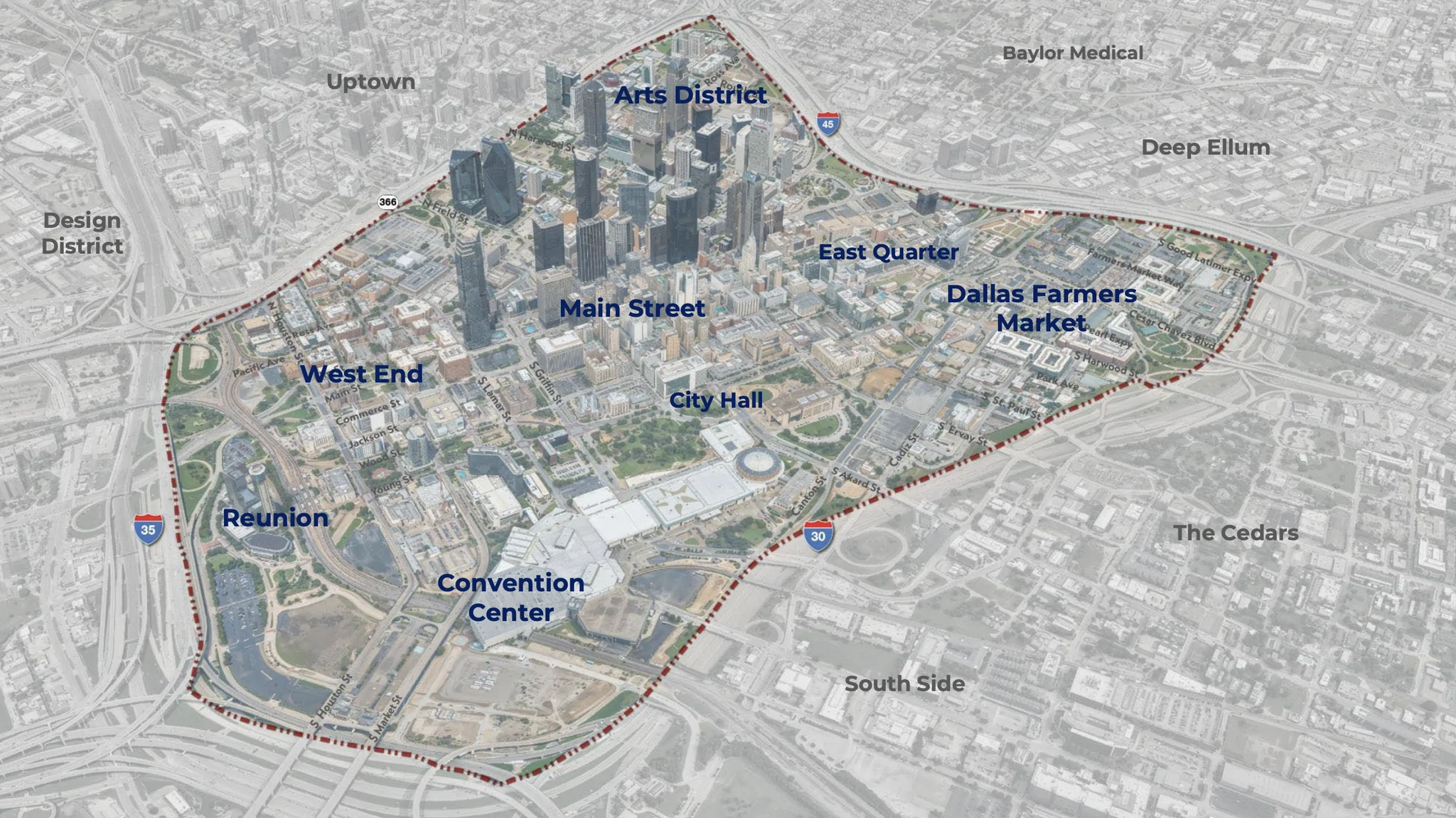
DDI’s plan rests on five priorities: more residents, a stronger economy, distinct districts, better ways to get around, and a better experience at street level. In practice, that means more trees, better sidewalks, bike and pedestrian routes, stronger connections between the Arts District, West End, Farmers Market, Main Street and the convention center, and new life for some of the surface parking lots that break up the core.
The plan doesn’t try to make every district look alike. It talks about strengthening each one’s personality while making it easier to get between them. A good downtown is a collection of places that work together, not one giant development.
Some of It Is Already Happening
Take 501 Elm Street, right by Dealey Plaza. The historic building is being converted to roughly 120 apartments with nearly 30,000 square feet of ground-floor retail. Twenty of the apartments are done, and the old vacant retail space now houses MoMoney, the Museum of Money.
MoMoney opened in February with 28 interactive exhibits across two floors. You don’t stroll quietly past display cases here. You touch everything, which gives people a reason to spend time in the area. People living upstairs, something to do downstairs and foot traffic on the sidewalk is the formula the whole plan is betting on.
Two bigger towers are in the pipeline. Comerica Bank Tower is slated for redevelopment with 240 apartments, a 242-room hotel and office space, and Bryan Tower is pursuing a conversion that could bring 426 apartments and ground-floor retail. Between them, they suggest every building and every block will end up with its own answer.
Then There’s Victory Park
DDI points to Victory Park as proof that a neighborhood can grow in stages. Housing came first, then businesses, amenities and jobs followed, until the pieces started working together. DDI CEO Jennifer Scripps has cited the Perot family’s investment, the housing that followed, and companies like Scotiabank moving in as parts of that story.
Nobody is suggesting downtown residents will move to Victory Park. It’s the model DDI wants to borrow. The open question is whether downtown can connect its own pieces well enough to do the same.
The Money Behind It
Real money is already moving. The convention center district represents roughly $3 billion in planned development, Dallas College is moving ahead with a $500-million-plus renovation of its El Centro campus, and Texas Woman’s University plans to open a downtown campus in fall 2027.
The convention center could bring a lot more activity to the south end of downtown, but DDI’s planner, Chris Beynon of MIG, has warned that if it isn’t done right, the convention center will stay an island. Housing works the same way. Thousands of apartments don’t help much if residents have to leave the neighborhood for groceries, kid activities or an afternoon outside. That’s why the walking, trees and street-level parts of the plan carry as much weight as the housing goal.
What Does This Mean for Real Estate?
There are no price points attached to Downtown Vision 2036 yet, and no list of new buildings with rents and delivery dates. It’s a framework. If you own a downtown condo, are thinking about buying one, or develop property, it’s the document to follow.
Downtown’s population has already grown about 68 percent in the last decade while Dallas as a whole stayed roughly flat, and DDI wants to push that much further. Whether another apartment building gets built is almost beside the point. What matters is whether the area around it, the shops, services, parks, streets, transit and entertainment, gets good enough that thousands more people want to stay. People have been asking that of downtown for years, and for once there’s a fairly detailed plan for how to get there.
A Neiman Marcus Update
The Neiman Marcus flagship on Main Street closed for good after 112 years. The beloved Zodiac Room is reopening at NorthPark on November 20, with its turquoise walls, popovers with strawberry butter and Stanley Marcus pot roast, and the holiday buffet runs through January 2.