You’ve probably heard the term “Y’all Street” by now. It started as a joke — a Texan wink at Wall Street, something people said loosely as financial firms began drifting south. But at a certain point, a joke stops behaving like a joke.
Goldman Sachs is building a campus here. Morgan Stanley has city approval for a $1.3 billion tower. The SEC approved a brand-new stock exchange headquartered in Dallas. And the New York Stock Exchange decided if you can’t beat them, join them — and moved to Dallas too.
I’ve been watching this city for a long time. What’s forming around Klyde Warren Park right now isn’t branding. It’s infrastructure. And if you own a home in North Dallas — or you’re thinking about buying — it’s worth understanding what’s actually being built, because the ripple effects reach further than most people realize.
The Bank of America Tower at Parkside
The Building · Uptown Dallas
At the corner of North Harwood Street and Woodall Rodgers Freeway — right next to Klyde Warren Park — a 30-story tower is rising that will become the tallest office building in Uptown when it delivers in early 2027. It sits on what developers describe as the last developable parcel directly adjacent to the park. There won’t be another one.
Bank of America has preleased floors 19 through 27 for its Dallas regional headquarters. The architecture is by Kohn Pedersen Fox — the firm behind some of the most significant towers in New York and London. The amenities read like what major tenants actually require right now: sky lobbies, outdoor terraces, conference facilities, fitness amenities, and ground-floor retail designed for daily use.
Here’s the detail that caught my attention: a portion of the construction is backed by a $290 million loan from Goldman Sachs Alternatives — the same Goldman Sachs that is simultaneously building its own 800,000-square-foot campus less than a mile away near the Perot Museum. Goldman is both a neighbor and a financier. That kind of overlap doesn’t happen by accident.
And on May 12, 2026, the Texas Stock Exchange signed a lease to make this building its permanent home, with plans to wrap a live market ticker around the building’s base. More on that in a moment.
The Texas Stock Exchange — and Why It’s a Bigger Deal Than It Sounds
The Exchange · Dallas, Texas
For most of American financial history, if you wanted to list a company or trade stocks, you went to New York. The NYSE and Nasdaq have run as essentially a duopoly for decades. No serious new exchange has received SEC approval since the 1970s.
On September 30, 2025, that changed. The SEC approved the Texas Stock Exchange — TXSE — as a fully integrated national securities exchange. First new one in decades. Headquartered in Dallas.
This isn’t a small experiment. TXSE has raised over $250 million from backers including BlackRock, Citadel Securities, Charles Schwab, JPMorgan Chase, Goldman Sachs, and Bank of America. One of its investors is Kelcy Warren — the Energy Transfer billionaire whose son Klyde Warren the park next door is named after. The plan is to begin trading in 2026 and accept primary listings including IPOs in 2027.
TXSE CEO Jim Lee said it directly: “Dallas is no longer just an emerging financial hub. It is a cornerstone of the country’s financial future.”
I’m inclined to believe him.
When the NYSE Decides to Come to You
The Competition · It Gets Bigger
Here’s where the story gets genuinely extraordinary. Rather than watch TXSE launch unopposed, the New York Stock Exchange didn’t fight it from New York. They came to Dallas.
NYSE Texas launched in March 2025 — the NYSE took its Chicago-based electronic exchange, relocated it, and set up operations at Old Parkland. AT&T, D.R. Horton, Halliburton, and Invitation Homes have already dual-listed. Then Nasdaq announced a second headquarters in Dallas as well.
So: three major stock exchanges — NYSE Texas, Nasdaq Dallas, and the homegrown TXSE — all planting flags in the same metro, within miles of each other, in the same two-year window. Dallas already hosts a Federal Reserve Bank and more Fortune 500 headquarters than any state except California.
The nickname stopped being ironic somewhere in there.
What’s Forming Around the Park
The Corridor · Klyde Warren Park
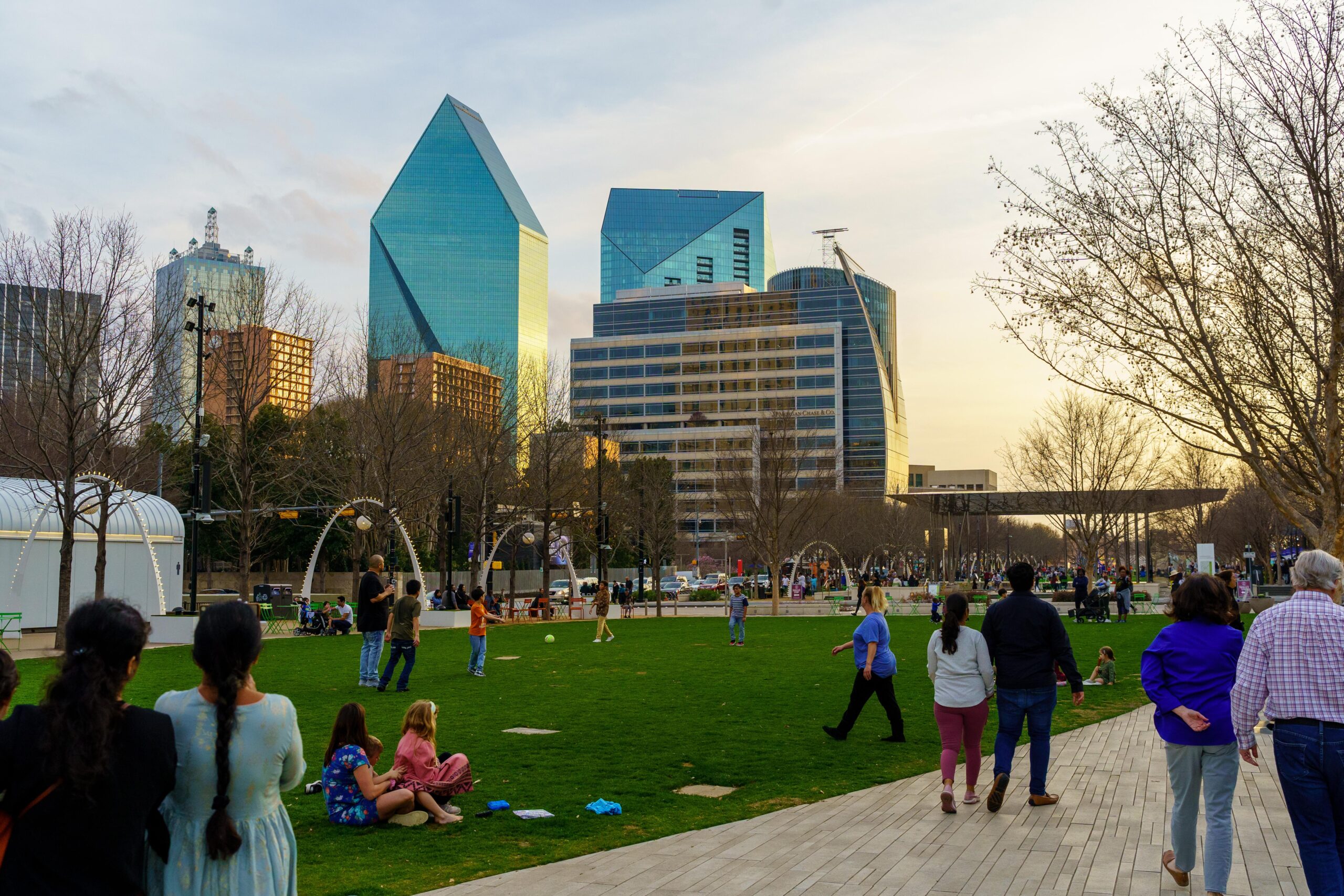
Stand at Klyde Warren Park and look in any direction. Goldman Sachs building on the north side near the Perot Museum. The Bank of America Tower rising on the south side. Morgan Stanley approved for a $1.3 billion tower at 2401 McKinney Avenue, five minutes away. 23Springs — a new 625,000-square-foot Class AA tower at Maple and Cedar Springs — just delivered and already 60% leased, with the first Dallas location of New York’s Little Ruby’s Café inside.
And now the Texas Stock Exchange signed its lease at the BofA Parkside tower — with a live market ticker planned to wrap around the building’s base.
This is a financial district forming in real time, organized around a 5.4-acre park that was a freeway in 2011. Klyde Warren Park draws over a million visitors a year and has become — as one developer put it — ‘the cultural center of gravity for Dallas, maybe the region.’ That gravity is now pulling capital at a scale the city hasn’t seen before.
And the park itself isn’t standing still. The city just announced a $120 million expansion — Klyde Warren 2.0 — that will add 1.7 acres, an indoor event space with a rooftop terrace, and a winter ice-skating rink. Construction starts later this year, completion by 2029. The park that was a freeway fifteen years ago is now getting a $120 million vote of confidence from the city. That tells you everything about where this corridor is headed.
What Happened to McKinney Avenue — and What’s Coming Next
The Neighborhood · Uptown Dallas
If you’ve spent time on McKinney Avenue over the past few years, you’ve probably noticed it’s changed. Morton’s closed at the end of 2024 after nearly 40 years. Other spots have quietly shuttered as leases expired and rents reset. The neighborhood that defined a certain era of Dallas nightlife isn’t quite what it was.
But here’s the honest read: Uptown isn’t fading. It’s changing customers.
When Goldman Sachs, Bank of America, Morgan Stanley, and the Texas Stock Exchange are your neighbors, the lunch crowd looks different than the bar crawl crowd. These are tens of thousands of people who need somewhere to eat on a Tuesday, somewhere to take a client on Thursday, somewhere to grab coffee before a 9am call. That demand is different from late-night margaritas — and it sustains a different kind of business. The hospitality economy around Uptown will rebuild around those workers. It always does.
And Klyde Warren Park sits at the center of all of it — yoga Tuesday mornings, food trucks at lunch, concerts on weekends. A park built over a freeway that is now the front yard of what may become one of the most significant financial corridors in the southern United States.
The Green Building — and What Happens to It Now
The Other Tower · Downtown Dallas
You’ve driven past it a thousand times without thinking about it. The one outlined in neon green on the Dallas skyline. That’s the Bank of America Plaza at 901 Main Street — a 72-story tower that opened in 1985 as the tallest building in Dallas, and briefly the 10th-tallest in the world.
Bank of America is leaving it. After nearly 30 years at 901 Main, they’re headed to Uptown. Which raises an obvious question: what happens to the green building?
The answer is one of the more interesting stories in downtown Dallas right now. Developers Mike Hoque and Mike Ablon are planning a $409 million transformation — a four-or-five-star hotel, street-level restaurants, renovated offices, and redevelopment across four surrounding city blocks. The Dallas City Council approved $103 million in tax increment financing in October 2025. Closing deadline: September 2026. Completion target: 2032.
The green lights are almost certainly staying. The redevelopment is about what’s inside and around the building, not the exterior that’s been part of the skyline for 40 years. Dallas is just writing a new chapter around it.
What If the City Itself Moves North?
And Then There’s City Hall · Downtown Dallas
Here’s the thread that ties all of this together — and it’s a big one.
Dallas City Hall — I.M. Pei’s dramatic inverted-pyramid building, opened in 1978 — needs hundreds of millions in repairs. Estimates run from $550 million to over $1 billion. So the city is now weighing whether to repair it or move operations elsewhere. Three buildings have emerged as frontrunners: Bryan Tower (a largely vacant 1973 high-rise on Bryan Street), The Epic in Deep Ellum, and Comerica Bank Tower, which is freeing up as Fifth Third Bank moves out. A decision is expected in late August.
The irony that’s hard to miss: Bryan Tower is actually an older building than the City Hall it would replace. And I.M. Pei’s own children — his son Li Chung “Sandi” Pei, an architect himself, and daughter Liane Pei — have both spoken publicly about wanting their father’s building saved.
But here’s the bigger picture. Downtown office vacancy is hovering near 30%. Bank of America just left its iconic tower for Uptown. The Texas Stock Exchange chose Uptown over downtown. Goldman Sachs built near the Perot Museum, not near Main Street. And now the city itself might follow — moving its own operations north while a developer bets $409 million on reinventing what’s left behind.
That’s not a coincidence. That’s a city showing you where it thinks its future is. The money is moving north. The question is what becomes of what it leaves behind.
Why This Is a Real Estate Story
The Bottom Line · What It Means for Home Values
The Klyde Warren corridor isn’t just an office story. It’s a residential one.
Tens of thousands of Goldman Sachs, Bank of America, Morgan Stanley, and TXSE employees are going to need somewhere to live. The neighborhoods within a reasonable distance of Uptown — Turtle Creek, Oak Lawn, the corridors along McKinney and Cedar Springs, and the surrounding North Dallas communities — sit directly in that demand radius.
That kind of employment anchor behaves differently from a single company or a single lease. These are institutions that don’t move lightly and don’t disappear with one bad market cycle. The residential demand they generate is sustained, not cyclical. And sustained demand is exactly what supports long-term property values.
What’s forming around Klyde Warren Park isn’t one corporate expansion. It’s a district — assembled through overlapping decisions made by banks, exchanges, developers, and the businesses that follow them.
Y’all Street started as a joke. At this point, the geography is becoming hard to ignore. And once you see where everything is clustering, the story stops being about a nickname. It becomes about direction.
Dallas isn’t waiting for its financial future to arrive. It’s building it — block by block — in one very specific part of the city. And I wouldn’t want a front-row seat anywhere else.
Sources: D CEO Magazine, Dallas Business Journal, KERA, The Real Deal, Dallas Innovates, Texas Tribune, CRE Daily, Commercial Property Executive, Dallas Morning News, June–July 2026.