
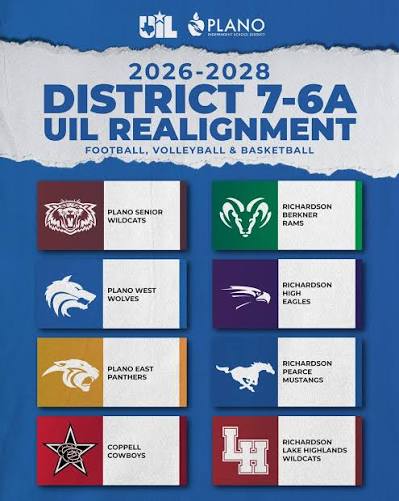
In February, the UIL released its biennial realignment —
the official reshuffling of which Texas high schools compete against each other in athletics for the next two years. It doesn’t usually make front-page news. But this one was worth noticing.
For the first time, Plano, Plano East, and Plano West will compete in the same UIL district as Richardson, Pearce, Berkner, and Lake Highlands. District 7-6A, effective fall 2026. Two school districts that have always run in parallel — equally strong, equally proud, equally committed to their kids — now on the same field, in the same bracket, measuring themselves against each other directly — for the first time in years.
The UIL decides district assignments based on enrollment, geography, and competitive fairness. When they put Plano and Richardson in the same district, they’re acknowledging something that anyone paying attention to North Texas already knows: these two cities have grown into each other’s league in every sense of the word. District 7-6A is going to be one of the most competitive in Texas — and that’s the point. — and this district reunites them for the first time in years.
And 2026 has made that case better than any year in recent memory.
Start with the schools, because that’s where it always starts. In May, the Richardson ISD school board approved $486.7 million in construction contracts to rebuild four junior high campuses from the ground up — Parkhill, Westwood, Richardson West, and Liberty — while adding significant new facilities at Apollo and Richardson North. It’s the largest school construction investment in RISD history. Four brand new buildings, all opening fall 2028. Buyers who purchase in those attendance zones now are buying before those schools get priced in. That’s not speculation — it’s how real estate has always worked.
And it’s not just the schools. The Richardson Public Library — which has been under a $48 million renovation since spring 2024 — is 85% complete and reopening in late September or early October as a four-story, 84,000-square-foot community hub with a makerspace, a seed library, 24/7 outdoor hold lockers, and wayfinding touchscreens on every floor. A city that invests $48 million in its public library is a city that knows exactly what it’s building for.
Plano ISD carries its own storied legacy — the area that stops a relocation conversation the moment you say it. And the private school ecosystem that’s grown up around both cities — Prestonwood Christian, Parish Episcopal, Hockaday, Greenhill, St. Mark’s, Ursuline, and others — tells you something too. When families with choices cluster in a geography, it’s worth paying attention.
But here’s what’s different about 2026: it’s not just the schools anymore. The corporate story has been building all year, and it’s genuinely something.
In Richardson, Celestica — a global leader in AI data center infrastructure — committed to a $300 million expansion at 2801 Telecom Parkway, bringing nearly 2,300 new jobs to the Telecom Corridor through 2036. Almost a million square feet of advanced manufacturing on a campus that used to be Fujitsu. Richardson adapted it. The Telecom Corridor — which also houses Texas Instruments, Collins Aerospace, Raytheon, and State Farm — isn’t slowing down. It’s adding capacity.
In Plano, the story is playing out on multiple fronts at once. Samsung is moving its U.S. headquarters to its existing Plano campus. AT&T is consolidating thousands of employees at its new 54-acre campus at Legacy Drive. The Park at Legacy — the former JCPenney headquarters on 107 acres — is being transformed into a billion-dollar mixed-use development. And voters approved all five Plano bond propositions in May, covering streets, public buildings, parks, sidewalks, and drainage, with no expected property tax rate increase. That’s a city managing its growth with discipline.
Both sports franchises made their bets on this corridor too. The Dallas Mavericks entered agreements to purchase roughly 104 acres at the Dallas Midtown site at Preston and LBJ — the heart of North Dallas. The Dallas Stars landed in Plano, with the city council approving $700 million toward a new arena at the Willow Bend site. Two professional sports teams, both choosing to come north, both by 2031. That’s not a coincidence. That’s a signal.
And then Niche released their 2026 Best Cities in America rankings. Plano: number six nationally. Richardson: number fifteen. Both earned A+ grades across schools, safety, jobs, cost of living, and quality of life. These aren’t cities peaking. They’re cities that have built something durable and are finally being recognized for it at a national scale.
When you put all of this together — the school investment, the library, the corporate commitments, the sports franchises, the bond programs, the national rankings — what you see is two cities that have been doing the right things for a long time and are now watching those decisions compound. That’s what the UIL realignment reflects. Not just that these kids are competing on the same field. But that these communities have earned the right to be in the same conversation.
Richardson’s Mayor Amir Omar shared something this month that fits perfectly here. A Richardson High School architecture student named Sean de Miranda created a 3D model of a community park he called Union Park — outdoor seating, a small garden, a safe play area, open space for neighbors to gather. A student project, not a funded development. But the mayor shared it and said: “This is what the future of Richardson looks like.”
In the middle of a year that has brought cranes and corporate campuses and billion-dollar announcements, an RISD student dreamed up a park with benches and a garden that would serve his community — and the mayor called it the future. Because when a city is moving this fast, the students growing up inside it are the ones who remember what all of it is actually for.
These cities are rebuilding their schools, expanding their libraries, attracting the best companies in the world — and Sean’s design is a reminder of what that investment is pointing toward. Not just academic rankings or corporate tax bases. Community. Neighbors. A place where people can sit with each other and slow down for a minute. That’s what families came here for. That’s what keeps them.
Same district now. Two cities, one field, and a generation of kids growing up in places their parents chose carefully. And every August, another round of college graduates will finish their degrees and face a choice about where to land next. A lot of them are going to come back to Richardson and Plano — back to the streets they grew up on, the schools they went to, the neighborhoods they already know by heart. Because these cities built something worth returning to. That’s not an accident. That’s the whole point.