
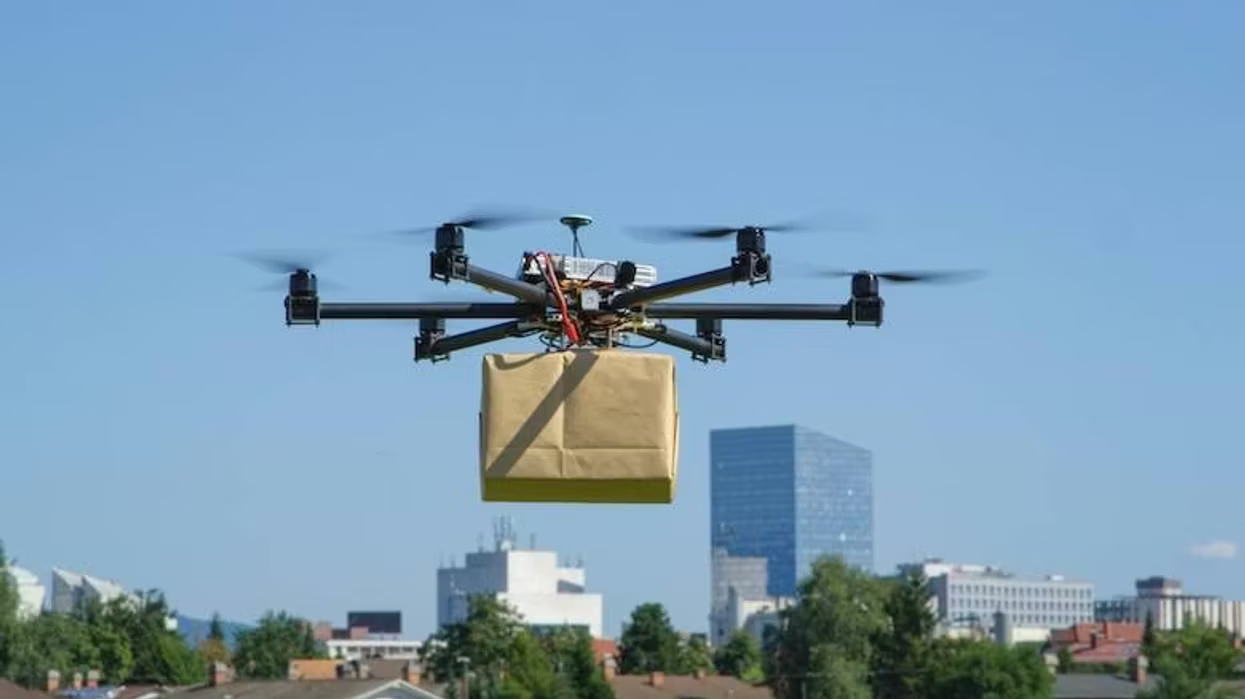
If you live in Richardson, Garland, or parts of Plano, you’ve probably heard them. A low, persistent hum. Something between a swarm of bees and a distant lawnmower. Every few minutes, sometimes every few seconds. Audible inside your home with the TV on.
That’s Amazon Prime Air. The company launched drone delivery operations from its hub at 3051 Research Drive in Richardson in December 2025, and since then the neighborhoods in the flight corridors have been living with something none of them voted for, none of them were warned about, and none of them are being compensated for.
I’ve been watching this story develop since the first complaints surfaced, and I want to be honest with you about something: this isn’t just a quality-of-life issue. It’s a real estate issue. And that means it’s something I have a professional responsibility to talk about plainly.
Here’s what’s happening, what the research says about what it could mean for your home’s value, and what you can actually do about it.
WHAT’S ACTUALLY HAPPENING
Amazon’s drones launch from Research Drive, travel up to 7.5 miles in any direction, and deliver packages in under an hour. The FAA limits most drones to 400 feet above ground level and speeds of 40–70 mph during delivery operations. Amazon was approved by the city council in a 4–3 vote in June 2025 — three council members voted against it from the start.
Once operations launched, the complaints came fast. One resident documented 122 drone overflights over her home in a single 10-hour period. A drone crashed into a building in February 2026. A street protest followed in June. The reason certain neighborhoods get hit so much harder than others is a quirk of geography: a mandatory FAA no-fly zone around Methodist Richardson Medical Center, right next to the Amazon hub, funnels the majority of drone traffic through a narrow residential corridor. Creek Hollow Estates and the area near Woodcreek Church have absorbed a disproportionate share of the load.
Amazon has made some adjustments. They raised minimum flight altitude to 225 feet on outbound routes, rerouted some northbound flights over commercial areas before entering residential corridors, and reduced traffic over the greenway east of Woodcreek Church. But residents say it’s not enough. The hum continues.
THE CITY IS PUSHING BACK
Richardson’s city leadership has been more responsive than most cities have been in similar situations. City Manager Don Magner has met multiple times with Amazon engineers. The full city council has formally requested a noise impact study, alternative flight routes, and stronger privacy protections. Dissenting council members have pressed Amazon to find routes that don’t consistently fly over the same residential streets and proposed dynamic route-spreading to distribute the burden more evenly.
The honest constraint: under federal law, the FAA has exclusive authority over U.S. airspace. Richardson cannot ban drones from flying, set altitude limits that conflict with FAA rules, or create no-fly zones without federal approval. The city’s tools are limited to pressure, advocacy, and negotiation — not regulation. That’s exactly why resident participation matters so much right now.
In March 2026, Amazon representatives presented to the City Council, covering delivery statistics, community feedback, and operational changes. The city has also set up a dedicated drone concern page at cor.net. They’re working the problem. Residents’ job is to keep the pressure on.
WHAT THIS MEANS FOR YOUR HOME’S VALUE
This is the part of the conversation that isn’t happening enough, and it’s the part I feel most obligated to address directly.
Decades of aviation research are consistent on one point: residential proximity to aircraft noise corridors measurably depresses property values. Hedonic pricing studies — economic models that isolate noise as a variable — consistently find a 5 to 15 percent reduction in residential property values for homes exposed to significant aircraft noise. Studies near Dallas/Fort Worth International Airport have documented similar patterns in surrounding suburban communities. The FAA’s own environmental review process acknowledges this as a known impact requiring mitigation.
Drone noise is its own category. Emerging research from the UK Civil Aviation Authority and university studies of Amazon Prime Air operations confirm that drone noise is perceived as more annoying than equivalent decibel levels from conventional aircraft, due to high-frequency tonal characteristics. That’s not a subjective complaint — it’s a documented psychoacoustic response that amplifies the perceived impact relative to traditional aviation noise.
At 65 decibels or above — a level consistent with reported drone noise at low altitudes — many states require noise disclosure in real estate transactions. Texas law is still evolving on this specific question, but some real estate professionals serving the Richardson/Garland corridor have already begun voluntarily noting drone corridor proximity in listings. When disclosure becomes standard practice, the market has already priced in a negative association.
Amazon pays nothing to homeowners whose property values decline due to flight corridor placement. Unlike airport noise mitigation programs, which can include soundproofing grants and other forms of compensation, no such protections exist for drone delivery corridors. The company bears none of the cost of the externality it creates. That’s a policy gap that will need to be addressed — and Texas has historically been protective of property rights, which means this is a conversation worth having with state legislators.
WHAT TO DO RIGHT NOW
There are concrete, coordinated actions that create real accountability. Here are the ones that matter most:
Submit a concern to the City of Richardson. The city has a dedicated drone concern page that routes your feedback directly into the official record. Every submission counts. cor.net/departments/community-services/code-enforcement/express-a-concern/drone-delivery
File an FAA noise complaint. The FAA tracks noise complaints and they factor into operational reviews. Document every incident with date, time, approximate altitude, and duration. One complaint is noise. Five hundred is a pattern that triggers formal review. Submit at faa.gov/noise/inquiries
Contact Amazon directly. Call 1-888-280-4331 or submit a complaint online and select “Something Else” then “Amazon Drone Delivery.”
Opt out of drone delivery in your Amazon account settings. Amazon’s utilization metrics drive their operational decisions. Reduced demand gives them less justification to maintain and expand the route over your neighborhood. Ask your neighbors to do the same.
Talk to your HOA. Many HOAs may have authority under their covenants to restrict drone delivery acceptance within their community — potentially cutting off Amazon’s customer base in your neighborhood. QuietSkiesTX has sample covenant language available at quietskiestx.org
Contact your state and federal representatives. Texas legislators can introduce legislation requiring community impact assessments before drone delivery corridors are established in residential areas. Your federal representatives can request updates on the FAA’s review of constituent concerns. Senator John Cornyn: cornyn.senate.gov. Senator Ted Cruz: cruz.senate.gov. Representative Julie Johnson: juliejohnson.house.gov
Amazon has made adjustments when pressed. The FAA approved these operations through a legitimate regulatory process. The city of Richardson voted to host the hub, and three of the seven council members who voted against it are still on that council fighting for residents. Drone delivery, done right, could genuinely reduce road congestion and carbon emissions over time. These are not nothing.
But the property value question is real, the disclosure question is real, and the noise burden falling disproportionately on a narrow residential corridor is real. Those are facts, not opinions. And homeowners in the affected areas deserve to understand them.
If you live in the flight corridors and you’re thinking about selling, call me. The disclosure question is evolving and you want someone who’s paying attention to it. If you’re thinking about buying near Research Drive, let’s talk about what we know and what we don’t. This is exactly the information a real estate agent who knows this corridor should be providing.
Submit a concern: cor.net/departments/community-services/code-enforcement/express-a-concern/drone-delivery
Community advocacy: quietskiestx.org
FAA noise complaint: faa.gov/noise/inquiries
Sources: City of Richardson cor.net Drone Delivery FAQ (confirmed July 2026), Amazon Prime Air Council Presentation March 9 2026, FAA Environmental Assessment January 2026, QuietSkiesTX.org property value research and advocacy resources, FAA Order 1050.1F Environmental Impacts, Hedonic pricing studies of airport proximity (NBER, Journal of Urban Economics), UK Civil Aviation Authority drone noise research, NBC5 DFW, Community Impact, Dallas Observer, June 2026.
This blog is for informational purposes only and does not constitute legal or appraisal advice. Real estate disclosure requirements vary by transaction and circumstance. Consult a licensed attorney for guidance specific to your situation.